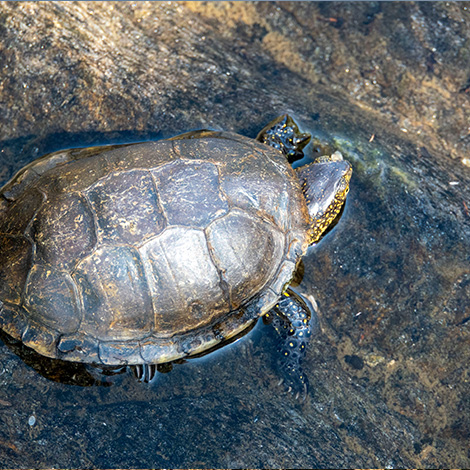
Are you hoping to attract turtles to your backyard pond? Over 60 turtle species roam North America, from Canada through Central America. The following four families comprise the most common freshwater turtles in the United States. See which of these shelled pals you can spot in your pond.
Terrapins (Emydidae)
Terrapins are a broad family of turtles commonly known as pond turtles. The family name Emydidae means “resembling a freshwater tortoise”, referring to their hard, ridged shells that are either domed or arched. If you live in the U.S., chances are your pond visitor belongs to one of the following genera.
Painted Turtles (E. Chrysemys spp.)
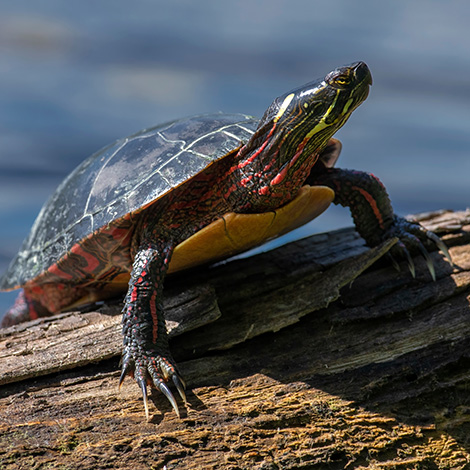
Characteristics: While their coloration may vary from dark brown to olive, depending on water clarity, all painted turtles feature distinctive yellow markings streaking from their eyes. These turtles are tiny, generally under 10 centimeters, with smaller males.
Range: Painted turtles are North America's most widespread genus of freshwater turtles, inhabiting southern Canada through northern Mexico.
Box Turtles (E. Terrapene spp.)

Characteristics: These turtles feature large, domed shells often adorned with yellow or pale green markings. While they are commonly sold as pets, they are quite sensitive and require specialized care.
Range: Box turtles are more terrestrial than most other pond turtles, often preferring woodland areas surrounding a pond or stream. They can be found in much of the United States east of the Rocky Mountains.
Sliders (E. Trachemys spp.)

Characteristics: Sliders encompass a wide variety of freshwater turtle types, and the most common species is the pond slider (T. scripta). These terrapins feature green shells, yellow bellies, and ornate yellow and red markings on their heads.
Range: Pond sliders live in the southeastern United States, while other species can be found from the Midwest through South America.
Cooters (E. Pseudemys spp.)
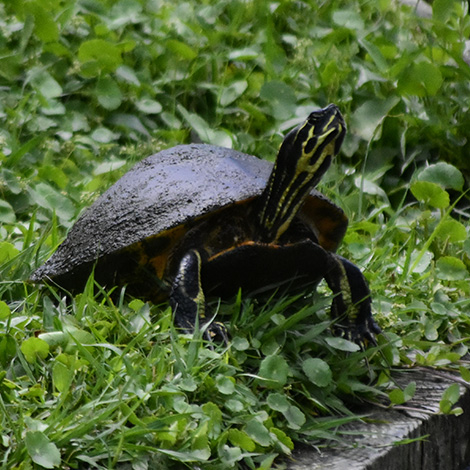
Characteristics: Cooters are large, herbivorous freshwater terrapins weighing up to 35 pounds. This genus encompasses a broad variety of colorings, but all cooters feature bright yellow or green marbling on their heads and necks and arched shells with small keels.
Range: Pseudemys predominantly reside in the southeastern United States and northeastern Mexico, although their range can extend into the Midwest and southeastern New Mexico.
Snapping Turtles (Chelydridae)
Freshwater snapping turtles are creatures you might want to repel from your pond if you are worried about losing prized koi fish. These carnivorous critters feast on fish of all sizes, which they snap up with their sharp, beaked mouths. Thankfully, you can relocate them humanely using a floating turtle trap.
Common Snapping Turtles (C. Chelydra serpentina)
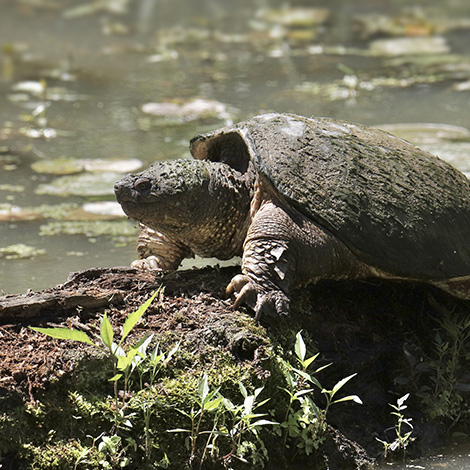
Characteristics: Most likely to snatch a koi from your pond, the common snapping turtle is a hefty reptile that can grow to weigh over 75 pounds. Their shells are often drab brown or green, and their snake-like heads enable them to snatch prey quickly.
Range: Common snapping turtles inhabit ponds, lakes, and streams in much of the United States east of the Rockies.
Alligator Snapping Turtles (C. Macrochelys temminckii)
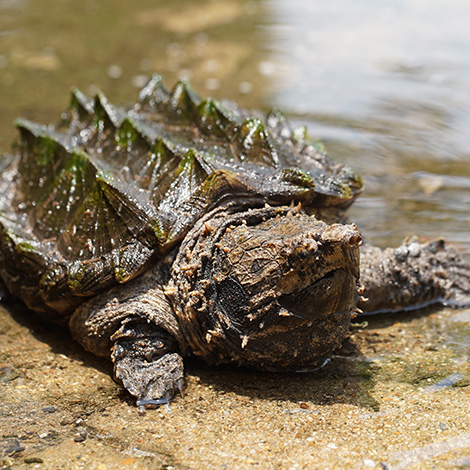
Characteristics: Larger and more aggressive than the common snapping turtle, alligator snapping turtles are some of the heaviest freshwater turtles in the world, topping 400 pounds. You can distinguish an alligator snapping turtle by the rows of spikes along its carapace.
Range: Alligator snapping turtles call the warm, freshwater areas of the Southeast home.
Softshells (Trionychidae)
Softshells are unique-looking aquatic turtles with long snouts and flexible, leathery shells. These adaptations make them adept underwater hunters, as their lightweight shells provide faster and more nimble movement, and their snouts act as snorkels when submerged.
Apalone (T. Apalone spp.)
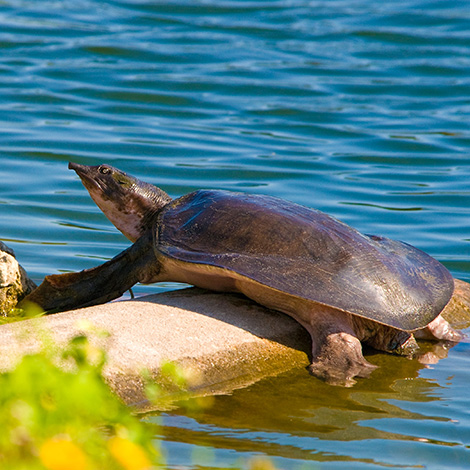
Characteristics: Softshell turtle carapaces are covered by leathery skin instead of hard scales. Smooth softshells have slick, flat, green shells, while spiny softshell carapaces feature black spots and spiny tubercles.
Range: Smooth softshell turtles are found in the United States east of the Rocky Mountains, while the spiny softshell inhabits most of the U.S. and into Canada and Mexico.
Kinosternids (Kinosternidae)
Kinosternids are small turtles with domed shells that prefer still or slow-moving bodies of water like your backyard pond. This family contains musk and mud turtles, and includes the only turtle species known to practice nest guarding—yellow mud turtles (K. flavescens).
Musk Turtles (K. Sternotherus spp.)

Characteristics: So-named for the musky smell they emit when threatened, musk turtles are a highly aquatic freshwater turtle genus in North America. They are typically small, under 17 centimeters long, and most have domed shells in drab, camouflaged colors.
Range: The six extant species of musk turtle reside in much of the eastern third of the United States.
Mud Turtles (K. Kinosternon spp.)
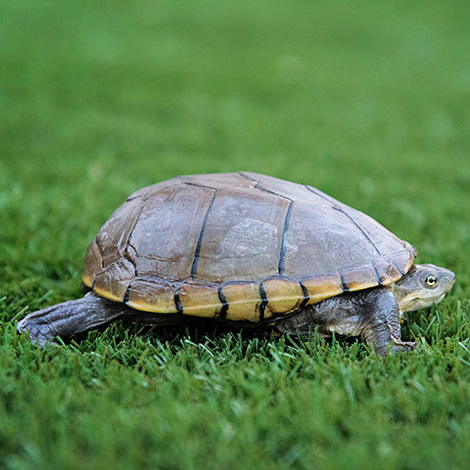
Characteristics: Mud turtles are visually quite similar to musk turtles, but their carapaces are much less domed.
Range: Mud turtles can be spotted throughout the entire continental United States, down to South America.
Outdoor Turtle Pond Ideas
Help attract native turtles to your backyard pond by keeping it clean and well-oxygenated with a diffused aeration system. If you have questions about creating a habitat in which pond turtles thrive, contact us online or call 866-POND-HELP to speak with one of our turtle-loving pond coaches.
Read more about pond wildlife in the following related guides:
Identifying Pond Wildlife Tracks
Freshwater Frogs of North America
Last Updated: August 15, 2025